
Istanbul 2026: Two Continents, One City, and Two Parallel Investment Realities


+ Table of content
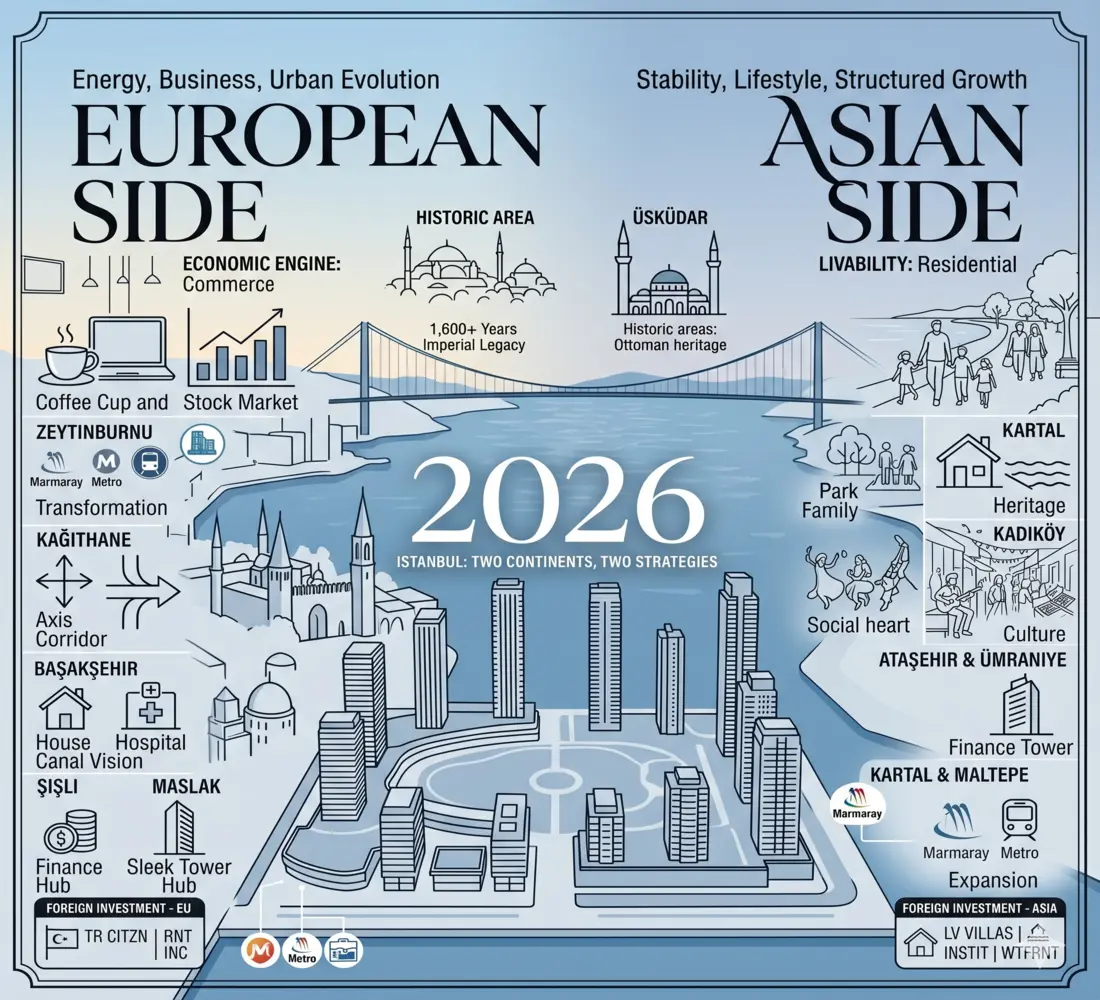
Istanbul is known globally as the only major metropolis in the world that sits on two continents, forming a vital bridge connecting Europe and Asia. The Bosphorus Strait bisects this exceptional city, dividing it geographically and demographically into two parts: about two-thirds of its area and population are located on the European side, while the remaining third settles on the Asian side. Today, this city embraces more than 15 million people, and operates as Turkey's beating heart of financial, cultural, and historical activities.
History of the city of Istanbul :
Istanbul carries within its folds an imperial legacy extending for more than 1,600 years, where it was the capital of the Byzantine and Ottoman empires (known historically as Byzantium then Constantinople). This historical depth is not just pages in books of the past, but it is a tangible reality manifested in its amazing architecture, its urban structure, and its unique cultural identity. The city was built on the banks of the Bosphorus Strait, a strategic waterway connecting the Black Sea to the Sea of Marmara, making it over the centuries a global crossroads for trade, migration, and culture.
In 2026, Istanbul merges this exceptional historical legacy with an extremely powerful modern identity. It is the economic center of Turkey, a major global city, and a rapidly expanding urban hub. Although the population density is concentrated on the European side, the two continents remain closely interconnected via a complex network of suspension bridges, underwater tunnels (like the Marmaray and Eurasia tunnels), and maritime ferry systems that draw the features of daily life.
The city embraces some of the most famous landmarks in the world. In the historic Sultanahmet area, the Hagia Sophia mosque and the Blue Mosque stand face to face in a majestic architectural dialogue, while the Topkapı Palace reflects centuries of Ottoman rule being the former residence of the sultans for more than 400 years. The Grand Bazaar remains one of the largest and oldest covered markets in the world, while the Basilica Cistern (the Sunken Palace) embodies the engineering genius of ancient Constantinople. On the other side of the Golden Horn, the Galata Tower and the modern Istiklal Street reflect the contemporary energy of the city and its renewable urban culture.
The cultural identity of Istanbul is formed from a charming mix of Islamic, Byzantine, and Western influences, which is clearly visible in its architecture, its diverse cuisine, its lifestyle and its daily rhythm. The city is known for a vibrant cafe culture, active nightlife, and strong social life, alongside its hosting of major events such as the annual Tulip Festival held in April of every year. With a transitional Mediterranean climate characterized by a hot summer and a cold winter, Istanbul provides a dynamic living environment that changes with the change of seasons, which increases its attractiveness to residents and investors alike.
This unique mix of history, geography, culture, and economic power continues to make Istanbul one of the most attractive real estate markets in the world, but at the same time it makes it one of the most complex markets; where a deep understanding of the fundamental differences between its two sides is considered crucial for any investor or resident.
Read more about | Best Offers for Apartments for Sale in Istanbul and Key Areas 2026
The European Side Of Istanbul : Energy, Business, and Constant Urban Evolution
The European side is considered the actual economic engine of Istanbul. Here are concentrated the tourism, financial, and commercial activities, and most of the large-scale infrastructure projects in the city. Life on this side is fast, intense, and highly interconnected. Hotels operate actively throughout the year thanks to the continuous tourist flow, and commercial areas operate at full capacity, while transportation networks expand incessantly.
What makes this side exceptionally powerful is the tremendous diversity within close geographical areas. Historical neighborhoods, luxury coastal areas, financial centers, and rapidly developing investment corridors sit next to each other, creating a real estate market characterized by high liquidity and speed of response to variables. Tourism is considered one of the strongest drivers of demand, especially in central areas, and at the same time, commercial areas like "Maslak" and "Levent" attract corporate tenants, while continuous expansions in infrastructure reshape real estate values throughout the city.
Main Areas on the European Side Of Istanbul : Transformation, Business, and Luxury Sectors
- Zeytinburnu and Topkapı: They are considered among the most important urban transformation areas on the European side. After being industrial areas in the past, today they are transforming into modern coastal and central residential areas enjoying strong transportation networks like the "Marmaray" line and metro networks. Their proximity to the historical peninsula adds great value.
- Prices: Range approximately between $2,200 to more than $6,000 per square meter, depending on the sea view and the quality of the project.
- Rental yields: Strong and usually range between 6% and 8%, supported by tourist spillover and professional demand.
- Kağıthane and Basın Ekspres: They represent one of the fastest growing investment corridors in Istanbul. Kağıthane is strategically located between Levent, Maslak, and Taksim, while Basın Ekspres has transformed into a linear axis for business and residence comprising offices, hotels, and modern residential complexes.
- Prices: Remain relatively affordable.
- Rental yields: Can reach 7% - 9%, especially for small units (studios and 1+1 apartments) that dominate the demand.
- Başakşehir: This area follows a different investment logic. It is an accurately planned residential area, characterized by wide streets, closed residential complexes, and massive infrastructure projects including the "Canal Istanbul" vision and major healthcare investments.
- Prices: Range between $2,600 and $4,500 per square meter.
- Rental yields: More moderate and range between 5.5% and 7%, with a focus on long-term capital value growth rather than short-term returns.
- The Luxury and Affordable Sector: The areas of Şişli, Beşiktaş, and Maslak form the financial and luxury heart of the European side, where they attract high-income professionals, international investors, and institutional demand. On the more economical end, areas like Beylikdüzü and Esenyurt offer large-scale housing projects with steady rental demand, especially for middle-income buyers.
Market Dynamics and Foreign Investment in the European Side Of Istanbul
In 2026, the European side remains an active, highly liquid market. Rental yields in strong areas range between 6% and 9%, supported by a diverse tenant base that includes tourists, students, corporate employees, and short-term tenants.
- Foreign investment here is very diverse. Buyers come from the Middle East, Russia, Europe, Central Asia, and Asia. Iranians, Iraqis, Russians, Germans, and Ukrainians are considered among the most active nationalities. Their motives are consistent: obtaining Turkish citizenship, rental income, and preserving capital over the long term.
- Gulf investors tend to focus on luxury areas like Beşiktaş, Şişli, and Zeytinburnu.
- Buyers from the European diaspora prefer affordable areas like Beylikdüzü and Esenyurt.
- Institutional investors are concentrated in Maslak, Levent, and Basın Ekspres, which enhances the institutional and commercial character of these areas.
Read more about | Best Apartments for Sale in Istanbul 2026 with Excellent Investment Features
The Asian Side (Anatolian) Of Istanbul : Stability, Quality of Life, and Structural Growth
The Asian side of Istanbul offers a completely different rhythm. It is quieter, greener, and predominantly residential with wide streets, coastal parks, and well-planned housing projects. Life here is less chaotic and more predictable, making this side particularly attractive for families and long-term residents.
It is also a fully developed urban area, where more than five million people live. Contrary to common perceptions, it is not a secondary part of Istanbul, but rather a major independent urban center. The main difference lies in the "lifestyle orientation". While tourism and business density drive the European side, the Asian side prioritizes livability, open spaces, and long-term comfort.
Main Areas on the Asian Side Of Istanbul : Culture, Finance, and Coastal Expansion
- Kadıköy and Moda: Kadıköy is considered the cultural heart of the Asian side. A vibrant, artistic area, filled with strong social energy with its markets, cafes, and cultural venues. The "Moda" area (which is part of Kadıköy) offers a quieter and more bohemian coastal atmosphere.
- Prices: Range between $3,000 and $5,000 per square meter.
- Rental yields: Range between 5% and 6%.
- Üsküdar: Represents the historical and spiritual identity of the Asian side. Characterized by Ottoman heritage, ancient mosques, charming water views, and a strong sense of tradition.
- Prices: Relatively higher, ranging between $3,800 and $6,500 per square meter, with stable demand and very low vacancy rates.
- Ataşehir and Ümraniye: They are the financial engines of the Asian side, driven by the establishment of the "Istanbul International Financial Center". These areas attract corporate tenants and professionals.
- Prices: Range between $1,200 and $2,800 per square meter.
- Rental yields: Range around 6% to 7%.
- Kartal and Maltepe: Represent the modern coastal expansion of the Asian side. They offer new residential projects, sea views, and a strong connection to transportation networks via the Marmaray line.
- Prices: Range between $1,300 and $2,500 per square meter.
- Rental yields: Range between 5.5% and 6.5%, supported by modern earthquake-resistant buildings.
Market Dynamics and Foreign Investment in the Asian Side Of istanbul
The Asian side is characterized by stability and long-term growth. Unlike the European side driven by short-term demand, the Asian side relies on real residential demand, infrastructure development, and corporate headquarters relocation trends.
The financial center in Ataşehir has formed a major turning point, generating strong and continuous rental demand from professionals in the financial sector. At the same time, ancient areas like Kadıköy and Üsküdar maintain their strong value due to their cultural importance and limited real estate supply. Vacancy rates are low, tenants stay longer, and the market is less volatile overall, making it attractive for investors looking for predictable performance.
Foreign investment is also distributed differently here: Gulf investors focus on luxury villas in Üsküdar and Beykoz, buyers from the European diaspora often choose Kadıköy or Erenköy, institutional investors concentrate in Ataşehir, while Russian buyers increasingly head to invest in Kartal and Maltepe.
Read more about | Villas for Sale on the Asian Side of Istanbul: Tranquility and Luxury in One Place
Looking for the best real estate investment opportunity in Istanbul?
We help you choose the right property based on your budget and goals
Analytical Comparison Tables for the Istanbul Real Estate Market 2026
For a clearer understanding of the complex dynamics, we present the following comparative tables:
Table 1: Comparison of General Investment Characteristics Between the Two Sides
| Point of Comparison | European Side | Asian Side |
| Pace and Lifestyle | Fast, intense, noisy, and vibrant | Quiet, residential, green, and stable |
| Economic Engine | Tourism, trade, permanent business | Long-term residence, the new financial center |
| Real Estate Liquidity | Very high (fast buying and selling operations) | Moderate and stable (long-term retention) |
| Rental Yields (Average) | High (reaching 6% - 9%) | Moderate and steady (reaching 5% - 7%) |
| Most Prominent Investment Goal | Cash flow, short-term returns | Capital growth, family stability |
| Tenant Turnover Rates | High (tourists, students, short stays) | Low (families, long-term contracts) |
Table 2: Comparison of Areas, Prices, and Rental Yields
| Area | Side | Nature of Area | Average Price per Square Meter ($) | Expected Rental Yield (%) |
| Zeytinburnu and Topkapı | European | Urban and coastal transformation | $2,200 - $6,000 | 6% - 8% |
| Kağıthane and Basın Ekspres | European | Investment and business axis | Competitive prices | 7% - 9% |
| Başakşehir | European | Planned residential communities | $2,600 - $4,500 | 5.5% - 7% |
| Kadıköy (and Moda) | Asian | Cultural and coastal heart | $3,000 - $5,000 | 5% - 6% |
| Üsküdar | Asian | Historical, luxury, heritage | $3,800 - $6,500 | Stable (low vacancy) |
| Ataşehir and Ümraniye | Asian | Financial and corporate center | $1,200 - $2,800 | 6% - 7% |
| Kartal and Maltepe | Asian | Modern coastal expansion | $1,300 - $2,500 | 5.5% - 6.5% |
Table 3: Distribution of Foreign Investment and Target Segments
| Nationality / Type of Investor | Preferred Destination in the European Side | Preferred Destination in the Asian Side |
| Gulf Investors | Beşiktaş, Şişli, Zeytinburnu (Luxury) | Üsküdar, Beykoz (Luxury Villas) |
| European Diaspora | Beylikdüzü, Esenyurt (Affordable prices) | Kadıköy, Erenköy (Familiar atmosphere) |
| Russian Investors | Diverse / Central areas | Kartal, Maltepe (Modern coastal projects) |
| Institutional Investment | Maslak, Levent, Basın Ekspres | Ataşehir (International Financial Center) |
Two Investment Logics : A Factor That Completely Changed Market Rules
The difference between the two sides comes down to the fact that the European side operates as a high-yield, fast-moving investment market, while the Asian side acts as a stable market for long-term wealth building. But what radically changed the market in Istanbul in recent years is that real estate ownership is no longer limited only to investment returns; rather, it has also become related to access and lifestyle.
At certain investment levels, purchasing real estate in Turkey grants the buyer a real estate residence permit (in areas open for civil registration), which allows foreign buyers to legally live in the country. And at a higher financial threshold, real estate investment opens the door to obtaining Turkish citizenship through buying a property, according to specific legal conditions. This led to a significant increase in international demand and a change in the demographic features of many buyers, as Istanbul no longer attracts traditional investors only, but has become a destination for those who want to actually live in it or take it as a second base.
Istanbul : An Exceptional Lifestyle Destination
The extent of Istanbul's development as a place to live, and not just for investment, is often overlooked. More foreign families are settling in the city thanks to its cultural depth, urban energy, and distinctive lifestyle. Compared to many major global cities, Istanbul still offers easily accessible financial entry points, while maintaining strong infrastructure, global connectivity, and a very active social environment.
Education plays a pivotal role in this transformation; as Istanbul possesses a wide range of internationally recognized universities, and prestigious private and international schools. For families, this is a decisive factor, meaning that the city is not only suitable for investment or short stays, but is ideal for long-term settlement with children.
Frequently Asked Questions (FAQ) : Istanbul 2026
The European side is characterized by a fast pace, high liquidity, and high rental yields, and is primarily driven by tourism, business, and major projects (suits those looking for cash flow). Meanwhile, the Asian side is characterized by stability, a quiet residential environment, and green spaces, and focuses on long-term capital growth and quality of life (suits families and long-term investors). The areas of the "Kağıthane" and "Basın Ekspres" axis are considered among the highest areas in terms of rental yields, where they can range between 7% to 9%, especially for small residential units like studios and (1+1) apartments that are highly demanded by the youth segment and corporate employees. The financial center in the "Ataşehir" area caused a major turning point in the Asian side; as it transformed the area and its surrounding areas (like Ümraniye) into financial engines attracting corporate headquarters and professionals in the financial sector, which generated a strong and continuous rental demand and pushed yields to reach around 6% - 7%. Yes, investment is no longer limited to financial returns only. Turkish laws allow foreign investors to obtain a legal residence permit upon purchasing a property of a certain value. And if the investment exceeds a higher, legally specified financial threshold, it opens the door for the investor and their family to obtain Turkish citizenship, which changed the nature of the demand to become directed towards "lifestyle" and legal privileges. The market is very diverse; Gulf investors usually prefer luxury real estate (like Beşiktaş and Şişli in Europe, and Üsküdar villas in Asia). Buyers from the European diaspora prefer areas with affordable and familiar prices (like Beylikdüzü or Kadıköy). Institutional investors focus on business centers (like Maslak and Ataşehir). Also, Russians, Iranians, and Iraqis are active in various areas of the city seeking residency or returns.
Conclusion: Istanbul 2026
In the end, Istanbul is not a city that you can describe in a simple linear way. It operates as two parallel systems constantly interacting but differing in how they work. The European side is dynamic, driven by opportunities, and focuses on performance and fast cash flow. The Asian side is more stable, focusing on housing, quality of life, and quiet growth.
Investing in Istanbul in 2026 is no longer about choosing the "better side", but about understanding how each part of the city works, and how that fits with your own strategy. Some look for high yield, others look for stability, while a third group looks for a place to live that offers an ideal balance between cost, quality of life, and long-term potential. Moreover, many experienced buyers are now combining properties on both sides to balance risks and returns within a single investment portfolio. And this diversity is exactly what makes Istanbul stand out: it allows all these strategies to exist and bloom within the borders of one great city.

 14-04-2024
 20,536
 30-05-2025
 10,856
 20-08-2025
 5,446